| Additional Training & Services: LEADERSHIP | TEAMS | 5 STEPS TO HIGH PERFORMANCE | ![]() | |
![]() | ![]() | |
![]() ![]() ![]() ![]()
"The results far exceeded expectations and achieved outstanding customer quality ratings."
"The seminars you conducted for my 90+ management team were a remarkable success." |
A Methodology for Redesigning Your Organization For High Performance
Many organizations are floundering, even going out of business. Others are changing the way they operate and getting tremendous results. Consider the following examples of companies that we've helped make the transition to high performance:
These are just a few of literally hundreds of businesses that are achieving outstanding results by changing the way work is organized and empowering the people who do that work. This is known as high performance work systems! A survey of the literature found that high performance companies achieve an average of 37% higher productivity on various measures of success. Our purpose is to help your organization become high performing, so you can achieve:
A clear strategy and "master plan" for managing and growing your business We link everything we do to your business objectives and key result metrics and document a return on your training or consulting dollars. Our proven consulting and training solutions have been used by dozens of companies. Since 1999, we have trained over 600 independent consultants to use many of our products. Most of them claim that we offer the best tools on the market today. In the pages that follow, we present an overview of a comprehensive organizational intervention designed to create high performance organizations that produce outstanding results in a number of areas. The following pages illustrate the value of targeting change at several levels and dimensions of business performance. It further describes each of the interventions and how they are carried out. The Transformation ModelThe transformation model is a framework to help leaders understand their organizations and also guide a successful redesign effort. The model reduces the vast complexity of an organization to seven key variables that must be understood and aligned for a business to be successful. Alignment implies a holistic or systems point of view that finds the best "fit" between all organizational elements. Paying attention to and understanding the major variables as defined by the model will result in major improvements in customer service, quality, efficiency, cycle time, profitability and satisfaction of employees.
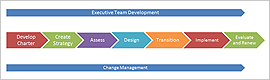
These seven variables form the "big picture" or context of an organization and ultimately determine its success. When we talk about organization design we are talking about the relationship and balance between each of these variables. The role of leadership in an organization could be defined as understanding and managing these variables. We'll briefly discuss each of the elements of the model to clarify their meaning and importance. Environment. Organizations, like all living systems, can survive only to the extent that they maintain harmony with their external environment. This includes being sensitive to the evolving needs and perceptions of customers, understanding changes occurring in technologies, knowing what the competition is doing and knowing the legal, social and political climates. Most organizations eventually die because they fail to maintain a responsive attitude towards their environment. Strategy. There are two parts to strategy. Business strategy identifies the reason for being of the business as well as the core competencies, objectives and factors critical to its success. A well developed business strategy tells the organization where it is going and guides it like a ships rudder in a stormy sea. An Organization strategy is the "being" or character of the organization. It has to do with who we are and not just what we do. It includes the mission, vision of the future, values and guiding principles. A clear organizational strategy helps transform a company or office from a normal work place to one that inspires people and brings out their best. Core Process. This is the flow of work through the organization. It is the sequence of events or steps necessary to get a product out the door or deliver a service. It usually cuts across department or organizational boundaries. It is, or should be, the focal point around which all other business unit activity is organized. Understanding, streamlining and properly supporting the core business process is the central job of any organization. Structure. Structure has to do with how people are organized around the core business process. It moves beyond box charts to understanding the boundaries, roles, responsibilities and reporting relationships among people. It is a sort of template that determines not only relationships but coordination of tasks and allocation of resources around the core business processes. The proper question about structure is not whether it is the right one, but whether it fits with the rest of the organization (core process, strategy) and helps rather than hinders performance. Systems. Systems are the inter related sets of tasks or activities that help organize and coordinate work. Examples include recruiting and selection, training and development, how people are promoted, communication/ information sharing, decision making, how people are rewarded, planning/ goal setting, personnel policies and procedures, performance feedback, etc. Systems are usually standardized and cut across the whole organization. They are often "owned" by management or special support functions. The most effective systems are often the simplest. Culture. Culture is how the organization really operates. It consists of the leadership style, worker attitudes and habits and management practices that make up the distinctive "personality" of the organization. It is like the air that permeates everything and is both cause and effect of organization behavior. Culture mirrors the true philosophy and values that the organization actually practices. As such, it is a measure of how well an organization has translated its philosophy (organizational strategy) into practice. Results. What is the organization's current performance? Results define the success or health of an organization and are therefore the starting point for understanding how well the organization is functioning. Results indicate where the organization is strong an what it needs to keep doing, as well as where it is weak and what it needs to change. Everything is tied to results. Not being clear about current or future results is like being lost at sea; even knowing where you want to go, you don't know how to get there. The Redesign ProcessThe purpose of the design process is to create and successfully implement a streamlined and effective organizational design perfectly aligned with the organization's philosophy and desired results. Many organizations, in spite of capable and well-intentioned people, fail to realize their potential because the structure, processes, and systems of the organization are barriers to efficiency and common sense decision-making. Organizations become "tar babies" to normally capable people who eventually grow disheartened and cynical by their inability to influence or change the limiting aspects of the organization's grip. The design process identifies the dysfunctional aspects of the work flow, procedures, systems, etc. and implements an efficient and responsive organizational design that facilitates outstanding results. Processes are streamlined, systems improved and traditional department boundaries are broken down as people become organized into cross-functional business units and teams that allow them greater authority and responsibility for their success. Although there is not a single way nor "right" way to make the transition to a high performance company, we have created a methodology that can be applied to most organizations. We'd like to share the steps of that methodology to give you an idea of how the process is accomplished. As we have defined it, there are three phases and 12 steps in the change process. Phase I: Direction SettingStep 1. Leadership awareness and commitment. Before embarking on a redesign effort it is necessary that the sponsor (s) of the project and senior leadership understand and be committed to the process. This step involves educating senior leadership about high performance work systems, the transformation model, the change process and needs driving organizational change. It is imperative that this group understand and be willing to commit fully the time and resources to the change effort. Step 2. Assessment of the business situation. The senior leadership do an overview of their current results and the business environment. They gather data about key business results, customer expectations, technology, vendor relationships and other social, legal or political demands on the business. This overview provides a common view of the business environment and much needed context for the next steps in the redesign process. Step 3. Strategy clarification. In this step, the senior leadership group examines both the business and organizational strategies. On the business side they will review or, if necessary, develop a mission statement, strategic intent, long range objectives and critical success factors. On the organizational side, they will review and/or develop their vision of the future, shared organizational values and guiding and operating principles. Senior leadership also establishes a general framework for the redesign process that includes allocation of resources, time deadlines and other parameters they want to guide the project. Step 4. Steering committee orientation. A steering committee is selected and chartered to oversee the redesign process. They are a multidisciplinary group of key people critical to the success of the project. Their role is to oversee the entire change effort, establish measures of effectiveness, choose and empower a design team and give final approval to all recommended changes. They also act as a buffer and communications link to the rest of the organization. They must be oriented to high performance work systems, the change process, the transformation model, the business situation and business and organizational strategy. This is generally accomplished in a 1-2 day orientation session. Phase II: Involvement and Redesign.Step 5. Organization Awareness and Commitment. After the steering committee formation, the rest of the organization needs to be made aware of the coming change process. The intent is to help all employees understand that there is an organization redesign effort underway that will seriously change the way the business operates and will significantly involve them over time. All-location communication sessions, department staff meetings, informal stand-up meetings, brown-bag lunch discussions and in- depth two-day orientation seminars are the means of communication. Education brings awareness, and everyone's inclusion brings the beginnings of commitment. Step 6. Design team charter and orientation. The design team is a group of employees selected and commissioned by the steering committee to do most of the work of the redesign. During a few days of orientation, they learn about the vision, values and guiding principles that have been developed by senior leadership. They also learn about high performance work systems, the transformation model and steps in the redesign process. Their job is to do an analysis of the organization and then develop redesign recommendations regarding each of the elements of the transformation model. During their orientation they learn the steps and are given specific tools to carry out their responsibilities. Step 7. Organization analysis. Analysis is a period of intense data gathering and discussion to discover who the organization is connected to, how its core business process(es) work (or don't work) and how people coordinate efforts to get work done. The design team leads the data gathering, holding one-on-one or small group interviews with different levels of employees, customers and other key stakeholders. They share results and conclusions with the steering committee and the rest of the organization. A thorough analysis is usually conducted of each of the seven elements of the transformation model including environment, strategy, core processes, structure, systems, culture and results. Step 8. Redesign process. After the analysis of the present state of the organization, results and key learnings are communicated and discussed with the steering committee. Now the redesign process can begin in earnest. The design team, and usually subject matter experts, will look towards the future and develop a complete set of design recommendations for their "Ideal Future Organization". They will first redesign the core business processes followed by the roles and responsibilities of people, including management and staff support functions, around those processes. Often, the design team's recommendations will point to cross-functional, self sufficient business units or teams. The design team will also make recommendations regarding ways the various systems of the organization can be better aligned with the new philosophy, core processes and structure. The recommendations of the team will include not only a snapshot of the ideal, also key milestones in a transition plan for how to get to that new organization. Phase III. Implementation and Evaluation.Step 9. Approval and implementation planning. Approval is the process of discussion, adjustment, acceptance and buy-in to redesign proposals. After the design team and steering committee meet and come to agreement on the design proposals they will make presentations to the rest of the organization or business unit in which the redesign is taking place. Transition plans and rough time frames have been developed and are presented as part of the redesign package. Implementation planning begins at this point and involves a cross section of employees who decide how they will make the new design happen. Step 10. Implementation. Once implementation plans are completed the task is to make the design live and work. During this phase, people are organized into natural work groups which receive training in the new design, team skills and start-up team building. New work roles are learned and new relationships within and without the unit are established. Reward systems, performance systems, information sharing, decision-making and management systems are changed and adjusted. Some of this can be accomplished quickly. But some of it, such as reward system restructuring, may be further detailed and implemented over a longer period of time. Aggressive goals and objectives should be set and carefully tracked during this time period to insure continued progress toward implementation of the new design. Step 11. Evaluation. A healthy organization is one that can measure its own performance, diagnose deficiencies, make plans for improvement and implement those plans to achieve desired results. Evaluation is the process of monitoring and maintaining organizational health by measuring performance against clearly established standards and goals. During implementation, when goals are met new ones are set. Similar to target analysis after target practice, evaluation of organization performance provides needed feedback to continue learning and improvement. Practically speaking, if targets are not posted before shooting takes place, it is impossible to measure accuracy. It is the same with organization evaluation; if goals and expected results are not identified ahead of time, it is difficult to accurately measure performance progress against them! If you begin with the end in mind, evaluation becomes a manageable and ongoing process. Step 12. Renewal. Renewal can begin some time around two years after the beginning of implementation. It is the careful comparison of the two-year-old organization against the ideal organization identified in the original redesign proposal. It can be viewed as a sort of mini-analysis to check organization design element by element to know how much progress has been made. This is often accomplished through interviews and discussion at several levels in the organization. Renewal is distinct from evaluation in that it occurs at a specific point in time and attempts to look at the whole organization and the integrity of the total design. It is not uncommon to see significant course adjustments or design changes come out of the renewal process. SummaryThis redesign process can be used by any organizations including manufacturing, service, government, health care or professional staffs. The steps may need to be modified or streamlined depending on the nature and size of the organization. Yet the same principles and general sequence of steps apply. Likewise, the same process can be used to redesign a large and complex organization, subunits of a large organization, or a small office or business. We have seen and worked with companies or business units as small as 10 members utilizing the principles of redesign to improve their performance. The length of time required to complete a redesign also varies depending on the nature, size and resources of the organization. Large and complex redesign projects can be completed within about six to nine months from step 1 through step 10 (the start of implementation). Smaller organizations require much less time and fewer resources to complete a project. This approach to redesign results in dramatic improvements in quality, customer service, decreased cycle times, lower turnover and absenteeism, productivity gains from 25 to at least 50%, etc. Although this methodology has been around for more than 40 years few companies have utilized it. Why? A big part of the answer is that throughout the 60s, 70s and into the 80s it was unnecessary. American businesses grew even when managed poorly. However, rapidly changing technologies, international competition and more educated workers have made that impossible in today's world. A second reason is lack of knowledge of a better way of doing business or the tools of organizational change. A final reason is fear and self protection. In high performance organizations department boundaries are changed, jobs descriptions are broadened, people have full authority to make decisions and solve problems related to their work and the role of management changes. This represents a radically different way of doing business that may be threatening to many managers and leaders. In spite of the potential for great improvements, many prefer the security of the familiar. There is no magic. There are no simple formulas. Real change requires commitment and hard work. However, for those who want to eliminate waste, improve quality, provide better customer service; for those who are willing to redefine their leadership role from one of controlling and directing to one of empowering others there is a powerful methodology for accomplishing those ends. Call or email the Center for Organizational Design today to design your organization for high performance. | ![]() |
|
|